Staff shortages in physiotherapy: Redistributing tasks
When job adverts come to nothing, it pays to look at how tasks are distributed: which activities genuinely require therapeutic qualifications, and where processes and technology free up capacity.
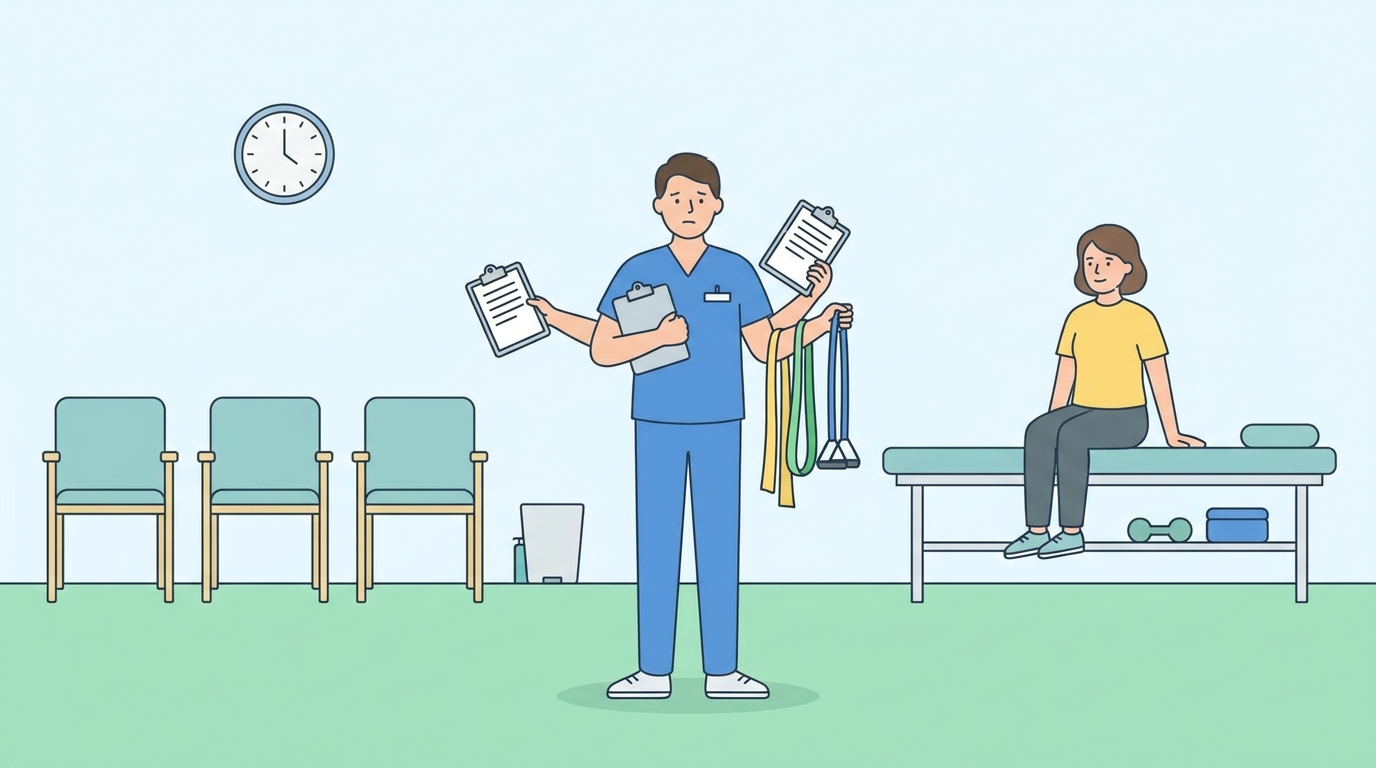
In many practices, vacancies stay unfilled for months. Extending a job advert changes little if there are no suitable professionals available. Staff shortages in physiotherapy are not only about the number of therapists available, but also about what their working hours are actually spent on in day-to-day practice. If you review the distribution of tasks systematically, you can often make better use of the capacity you already have – regardless of when the next position is filled.
Staff shortages in physiotherapy: The bottleneck is therapist time
A job advert assumes that suitable candidates are available, that there is capacity for onboarding and that an additional position is economically viable. Depending on the region and the practice, meeting these conditions can be a challenge.
That is why, alongside recruitment, a second question is worth asking: how much therapist time is spent each week on tasks that could also be organised differently or supported by technology?
In everyday practice, this includes administration and phone calls, documentation written up after the event, recurring inductions in the training area, as well as organisational losses caused by cancellations, rescheduling and gaps in the appointment calendar. Taken individually, these tasks often seem manageable. Taken together, however, they can have a considerable effect on the treatment capacity actually available.
Task inventory: Two weeks of note-taking, then sort
Before changing any workflows, it is worth looking at your own practice. One possible approach: for two weeks, all team members note down activities outside direct treatment and roughly estimate how much time they take. There is no need to record this to the minute. The tasks can then be sorted into different categories:
- Must remain therapeutic: assessment, treatment planning, manual techniques, adjusting load and progression, as well as conversations about progress and therapy goals.
- Can be transferred organisationally: for example phone calls, appointment booking, administrative prescription checks, preparing billing, ordering materials or reception duties.
- Can be standardised: recurring information content, intake forms, case history questionnaires, prepared training modules or progress reports following a consistent template.
- Can be supported by technology: for example appointment reminders, recording training data, digital exercise instructions or the preparation of progress values.
Sorting tasks in this way creates transparency first of all. At the same time, it becomes clear which activities explicitly require therapeutic expertise and which tasks could sensibly be supported organisationally or technically.
Delegation with clear responsibility – and within the relevant legal framework
Delegation does not mean handing over therapeutic responsibility. What matters is defining tasks and responsibilities unambiguously.
For any transferred activity, three questions should therefore be settled: who carries out the task? How can you tell that it has been done correctly? And when does the responsible therapist have to be involved?
Which tasks may be carried out and documented by whom in the case of prescribed services depends on the applicable professional, licensing and contractual requirements. There are differences between Germany, Austria and Switzerland, and between different models of care. Planned changes should therefore be checked against the rules that apply in your own setting.
Administrative activities such as reception, appointment organisation or materials management are often easier to transfer organisationally. Here, too, it should be clearly defined who is responsible for which task.
Possible organisational roles include, for example, a team member for reception, appointment management and prescription logistics, or a designated person for organising the training area and the equipment. What counts is not the specific job title, but a clear distribution of tasks that deploys therapeutic expertise where it is genuinely needed.
Processes before people: Four levers in the daily routine
Alongside the distribution of tasks, it is worth looking at the processes that tie up therapist time every day:
- Appointment architecture rather than simply booking appointments: fixed time slots for initial appointments, follow-ups or training sessions can make the working day more predictable. The article Reducing waiting times in physiotherapy: Planning instead of pace describes how to review appointment structures in a targeted way.
- Documentation as close to the service as possible: information recorded during or immediately after a session does not have to be reconstructed from memory later on. The article Training documentation in physiotherapy: What really counts? looks at which content is actually relevant.
- Standardised starting points: prepared training modules for common goals can be adapted individually without having to build basic workflows from scratch every time.
- Technical support for recurring training processes: digital systems can help with exercise instruction, movement feedback and the recording of training data, for example.
The last point in particular is interesting wherever training workflows can be standardised sufficiently. Technology does not replace a therapeutic decision, but it can support recurring tasks within the training process.
How the Pixformance Station supports training and documentation
This is where digitally supported exercise therapy comes in. The Pixformance Station is a digital training and therapy unit with an integrated camera system and a virtual trainer. Movements are captured while the exercise is being performed, and visual and written cues are given directly.
The virtual trainer demonstrates the exercise in question while the system guides the execution. Training parameters are documented automatically and can then be viewed via the online platform.
For everyday practice, this means that recurring elements of training such as exercise prescription, immediate feedback and the recording of training data can be supported by technology. Assessment, therapy planning and the decision on the selection, dosage and adjustment of exercises remain with the therapist.
Pixformance has also been examined in various clinical and scientific projects. These include research on technology-supported exercise therapy as well as the European research project FORTEe on exercise therapy in paediatric oncology. The results of such investigations should always be considered in the context of the study design, the target group and the specific research question.
| Criterion | Pixformance Station | Strength equipment without automated feedback | 1:1 supervision by a therapist | Exercise sheets and home exercise apps |
|---|---|---|---|---|
| Feedback during execution | automated visual and written feedback | depends on equipment and supervision | individual feedback from the therapist | depends on the particular application |
| Exercise instruction | virtual trainer demonstrates the stored exercise | depends on equipment and supervision concept | direct instruction by the therapist | possible via text, images or videos |
| Training documentation | training data is recorded automatically | depends on equipment and practice processes | therapeutic documentation required | depends on application and data capture |
| Use of staff | depends on patient, training goal and supervision concept | depends on the form of training and supervision needs | staff are directly tied up during treatment | low direct supervision requirement possible |
| Individual adaptation | training plans can be adapted therapeutically | depends on equipment and supervision | immediate individual adaptation possible | depends on application and supervision |
| Training outside the practice | supplementary digital options possible | generally not provided for | depends on the agreed home programme | often part of the concept |
| Scientific investigation | examined in various clinical and scientific projects | depends on the particular device and field of use | broad evidence base depending on the therapeutic method | varies depending on the application |
The different approaches fulfil different purposes. For complex findings, manual techniques and situations in which immediate therapeutic decisions are required, personal supervision remains central. Digital systems can primarily help where exercises are to be performed repeatedly, guided and documented.
Another possible area of use is supplementary self-pay services. The article Building self-pay services: A realistic path for small practices describes how such an offering can be planned organisationally and economically.
Implementation: An order of play for the coming weeks
Do not start with a technical solution, but with the workflows in your own practice. First, record over a limited period which tasks outside direct treatment regularly take up therapist time, and evaluate them as a team.
In the next step, you can select a small number of activities whose organisation is to be reviewed. Define who will be responsible in future, which quality requirements apply and when the therapist has to be involved. To begin with, it can make sense to focus on only a few changes at a time.
After that, it is worth taking a close look at the training area. Which workflows need therapeutic supervision? Which recurring elements can be standardised? And for which tasks might technical support be useful? Take into account both the potential costs and the changes in time required, in documentation and in daily workflows.
The article Digital exercise therapy: Which measurements really hold up looks at which progress values are genuinely relevant in digitally supported training.
Even optimised processes do not replace the search for qualified professionals. Clear responsibilities, standardised workflows and sensibly deployed digital support can, however, help to use the therapist time you already have more purposefully. This does not make a practice independent of the labour market – but it does mean that additional capacity need not come exclusively from new positions.
Frequently asked questions
Which tasks should practices hand over first when staff are short?
Administrative activities have the fastest effect: phone calls, appointment management, prescription logistics, preparing billing, ordering materials as well as hygiene and equipment care. Added to this are the organisation and supervision of the training area outside prescribed services. Assessment, treatment planning, manual techniques and the adjustment of load and progression remain therapeutic tasks. Check the legal requirements and billing rules in your country before making any change.
How can you improve the staff-to-patient ratio in the training area?
The basis is fixed time slots, defined group sizes and a clear handover between therapy and training. For several people to train meaningfully at the same time, feedback during execution is needed. The Pixformance Station captures 25 joint points in real time, gives corrective feedback and allows up to four people to train simultaneously, while the professional instructs and sets priorities.
Is technology worth it when staff are lacking anyway?
Technology does not replace a professional, but it does shift tasks. What matters is a calculation with your own figures: monthly costs against the additional sessions made possible and the documentation time saved. If that does not add up, process levers remain – appointment architecture, documentation at the point of service and standardised training modules. They cost little and also take measurable pressure off the calendar.
How do you prevent delegation from feeling like a demotion within the team?
A shared task inventory helps: for two weeks the team records all activities outside treatment and sorts them into therapeutic, delegable, standardisable and technically supportable. Once it becomes visible which tasks explicitly remain therapeutic, handing over the rest is experienced as relief. Every transferred task needs a responsible person, a quality marker and an escalation route.
Read more

Staff shortage in physiotherapy: Figures and ways out
The Therapy Efficiency Report 2026 shows how much therapist time goes into tasks that can be standardised – and how practices can gain capacity without hiring additional staff.

Building self-pay services: A realistic path for small practices
How small practices can develop a viable second income stream – from choosing a target group to pricing and process planning, through to communication without sales pressure.
Reducing waiting times in physiotherapy: Planning rather than pace
How practices can shorten waiting times with a robust appointment grid, deliberate buffer times and complementary group sessions, without cutting treatment time.