Reducing waiting times in physiotherapy: Planning rather than pace
How practices can shorten waiting times with a robust appointment grid, deliberate buffer times and complementary group sessions, without cutting treatment time.
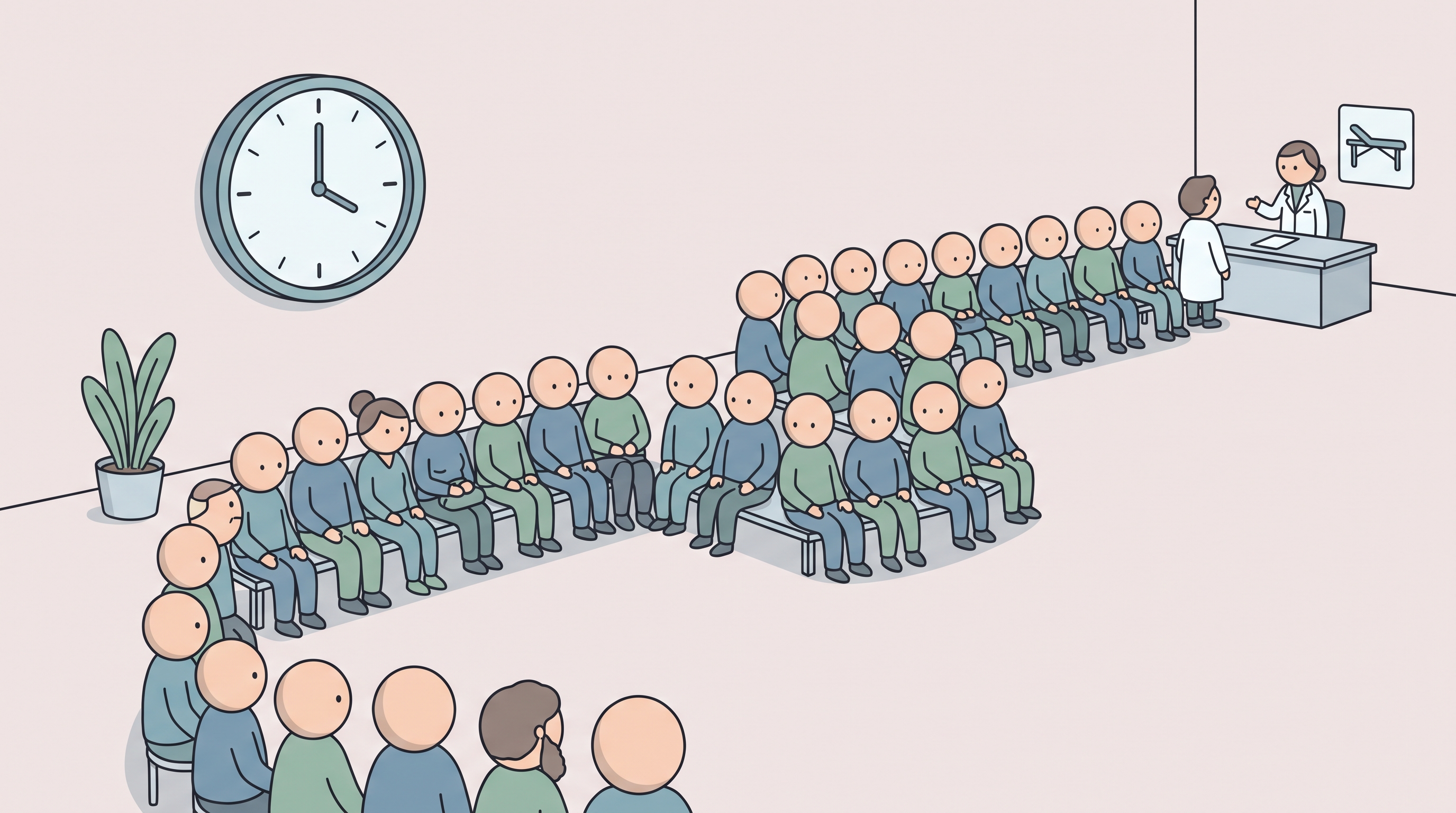
The waiting list stretches over weeks, the waiting room is full all morning and the schedule is already behind before the lunch break. Anyone who responds to this situation by cutting treatment times or squeezing appointments closer together usually just pushes the problem further down the line. If you want to shorten waiting times in physiotherapy, you should above all review the structure of your schedule, plan buffers deliberately and add suitable forms of care.
Waiting times arise in different places
In practice, waiting times and bottlenecks arise in different places. These include the time between an enquiry and the first treatment appointment, delays during the day, idle time caused by short-notice cancellations, and unfavourable intervals within a treatment series. Each of these problems calls for a different approach.
| Type of waiting time | Common cause | Effective starting point |
|---|---|---|
| Waiting time until the first treatment appointment | More enquiries than plannable capacity, prescriptions with a fixed frequency | Capacity management, group and complementary services, admission criteria |
| Delay during the day | Grid too tight, missing buffers, overrunning at initial assessments | Ãcycle times, buffer blocks, differentiated appointment types |
| Idle time due to cancellations | Short-notice cancellations, no-shows | Reminders, standby list, clear cancellation policy |
| Waiting time within the series | Unfavourable distribution of frequency across the week | Series planning, fixed recurring slots |
The overview makes it clear that there is no single lever against waiting times. Two practices with similarly long waiting lists may have completely different causes behind them. That is why the starting point should not be a single measure, but a stocktake over two to three typical weeks.
Reducing waiting times in physiotherapy: The appointment grid as the basis
The appointment grid is one of the most important organisational levers a practice has, and it is often carried on unchanged for years. A grid consisting exclusively of slots of equal length forces every treatment into the same format: the short follow-up appointment uses up as much time as the demanding initial assessment, which may regularly need more time than allocated.
It therefore makes sense to differentiate by appointment type in a way that reflects the actual time required. Typical categories are:
- Initial assessment and re-evaluation: a longer slot, because history-taking, tests, goal-setting and documentation all come together.
- Routine treatment within an ongoing series: standard slot, easy to predict.
- Training and follow-up appointment: shorter slot with a clear structure, often possible with parallel supervision.
- Brief contact: adjusting load, checking aids, answering questions about the home programme.
What matters is that slot lengths are not estimated but measured. Over a few weeks, note when a treatment actually begins and ends. If one appointment type systematically overruns, that is an argument for taking a closer look at the allocated slot length and the workflow. Correcting it upwards costs capacity at first, but saves the knock-on delay across the rest of the day.
Thinking appointment types and the logic of the day together
Demanding initial assessments late in the afternoon can be organisationally awkward, because delays are harder to absorb towards the end of the day. If you place demanding appointment types in the first half of the day or directly before a buffer block, you spread the risk more effectively. It is equally helpful to allocate series appointments as fixed recurring slots wherever possible. Every gap that has to be searched for anew ties up time at reception and creates leftover holes that are difficult to fill later.
Buffer times as a design principle, not a leftover
Buffers rarely emerge on their own. In well-utilised practices, every free minute is allocated until the schedule has no reserve left. A day without reserve responds to every disruption with a delay, and that delay grows over the course of the day because there is nowhere for it to be absorbed.
Two forms of buffer are practicable and complement each other:
- Micro buffers: a few minutes per slot reserved for changing, moving between rooms, hand disinfection and documentation. This time is part of the service, not idle time.
- Block buffers: a slot deliberately kept free during the morning and the afternoon. It serves as a catchment for overruns, as space for acute enquiries and, if nothing comes up, for documentation or phone calls.
For block buffers to survive, they need a rule: who may allocate them, from when and for what purpose? Without that rule, the buffer will be dissolved in the first busy week. One possible rule is to release the block buffer only at short notice – for example the day before – and to use it specifically for urgent enquiries or rescheduled appointments.
The economic perspective matters here: buffers are not wasted capacity. They replace unproductive delay time, reduce overtime at the end of the day and lower the number of appointments that have to be cut short because of a backlog. That is exactly where the link to quality lies.
Group sessions as a release valve for the one-to-one grid
An important lever against a long waiting list is rarely more pace in individual appointments, but a different form of care for those patients who mainly need instruction, load management and monitoring. In the later phase of a series, the focus of many cases shifts from hands-on individual treatment to supervised, progressively increased training. For this, a supervised group or circuit format is often the more suitable structure organisationally.
Typical design features of such services:
- fixed weekly appointments with a limited number of participants, matched to the room and equipment available
- clear entry criteria, such as sufficient load tolerance and the ability to perform the basic exercises independently
- individual training plans within the shared time window, so that management remains person-specific
- regular individual appointments for re-evaluation, planned into the grid rather than sought spontaneously
- documented criteria for stopping and referring back if symptoms increase
The effect on the waiting list comes from freeing up individual slots that were previously tied up by cases with a low need for supervision. Those slots then become available for initial assessments and for cases with a higher level of need. The prerequisite is that the allocation is made on clinical grounds and not according to capacity utilisation. A group allocation made solely to relieve pressure on the schedule, by contrast, can compromise the quality of care.
Digital training support can underpin such formats by documenting exercise plans, load specifications and feedback in a structured way. Depending on the system, this can make supervision easier and help to make deviations in the course of training traceable.
What protects treatment quality
Every measure aimed at shortening waiting times can tip over into intensification. That is why guard rails belong alongside them, defined in advance and not negotiated in the middle of day-to-day business:
- The nominal treatment time with the patient is not cut in order to catch up on delays.
- Initial assessment and re-evaluation keep their full time, even when the day is under pressure.
- Documentation takes place within working hours, not after the shift ends.
- Parallel supervision remains tied to criteria: independence, stability of the case, clear visibility across the room.
- There is an upper limit per shift for demanding appointment types.
These points are also a leadership tool. They give the team a reason not to squeeze in another appointment, and they relieve reception of making individual decisions under pressure.
Metrics that make progress visible
Without measurement, the debate about waiting times remains a matter of impressions. Four figures can be tracked in almost any practice software, or on a paper record sheet if need be:
- Waiting list duration: the time between enquiry and first appointment, broken down by appointment type.
- Punctuality rate: the proportion of appointments that start within a defined tolerance window.
- Cancellation rate: the proportion of appointments cancelled at short notice or not attended, including the question of how many of them were refilled.
- Buffer consumption: the proportion of block buffers actually needed for disruptions.
If buffer consumption is persistently very low, there is reserve to spare. If the buffer is needed almost in full, the grid is fundamentally calculated too tightly. This single metric often answers the question of whether adjustments are needed more clearly than the length of the waiting list alone.
Putting it into practice
Start with a measurement week in which you do nothing but record: planned and actual start and end times, appointment type, cancellations. In the second week, evaluate as a team which appointment type systematically overruns and at what time of day the backlog builds up. From this, derive a new grid for a test period of around six to eight weeks, initially for just one treatment room or one shift, so that ongoing operations do not have to be completely reorganised.
In parallel, define the buffer rule in writing and name one person who decides on its release. It is best to start a group service with a single fixed weekly appointment, clear entry criteria and a limited number of participants that suits the room. After the test period, compare the four metrics with the baseline measurement and decide whether to extend the grid to further shifts.
One thing that is often underestimated: the greatest gain does not necessarily lie in more appointments being allocated, but in a more reliable daily routine. A robust appointment grid can reduce waiting times on site, prevent overtime and help you communicate available appointments to patients more reliably.
Frequently asked questions
How can waiting times be reduced without cutting treatment time?
The lever lies in the structure, not in the pace. Differentiate appointment types according to realistically measured time requirements, plan micro buffers for changing and documentation as well as one block buffer per half-day, and move training-dominated cases into supervised group formats. This frees up individual slots for initial assessments while the nominal treatment time remains unchanged.
How much buffer time should a schedule contain?
There is no universally valid figure, because patient mix, room distances and appointment types vary considerably. Use measured buffer consumption as your guide: if the reserve is needed in full almost every day, the grid is calculated too tightly. If it remains permanently unused, you can release capacity. Two block buffers per day are a workable starting point for a test period.
When does a group service make clinical sense?
When the focus of a case shifts from hands-on individual treatment to guided, progressively increased training, and the person can perform the basic exercises independently and with stable load tolerance. The prerequisites are written entry criteria, individual training plans within the shared time window, scheduled individual appointments for re-evaluation and clearly defined stopping criteria if symptoms increase. Allocation is made on clinical grounds, not according to capacity utilisation.
Which metrics show progress in appointment scheduling?
Four figures are enough to begin with: the waiting list duration between enquiry and first appointment, the punctuality rate within a defined tolerance window, the cancellation rate including refilled slots, and buffer consumption. Record these values in a measurement week first as a baseline and compare them after six to eight weeks of trial operation with the new grid.
Read more

Digital exercise therapy: Which metrics really hold up
Movement data is now generated almost as a by-product. What matters is which of it actually changes a therapeutic decision – and which only ties up storage space and analysis time in your practice.

Building self-pay services: A realistic path for small practices
How small practices can develop a viable second income stream – from choosing a target group to pricing and process planning, through to communication without sales pressure.

Training documentation in physiotherapy: What really counts?
Between mandatory record-keeping and training control: a structured look at which details belong in the patient file, which data support therapeutic decisions and which documentation fields you can do without.