Training documentation in physiotherapy: What really counts?
Between mandatory record-keeping and training control: a structured look at which details belong in the patient file, which data support therapeutic decisions and which documentation fields you can do without.
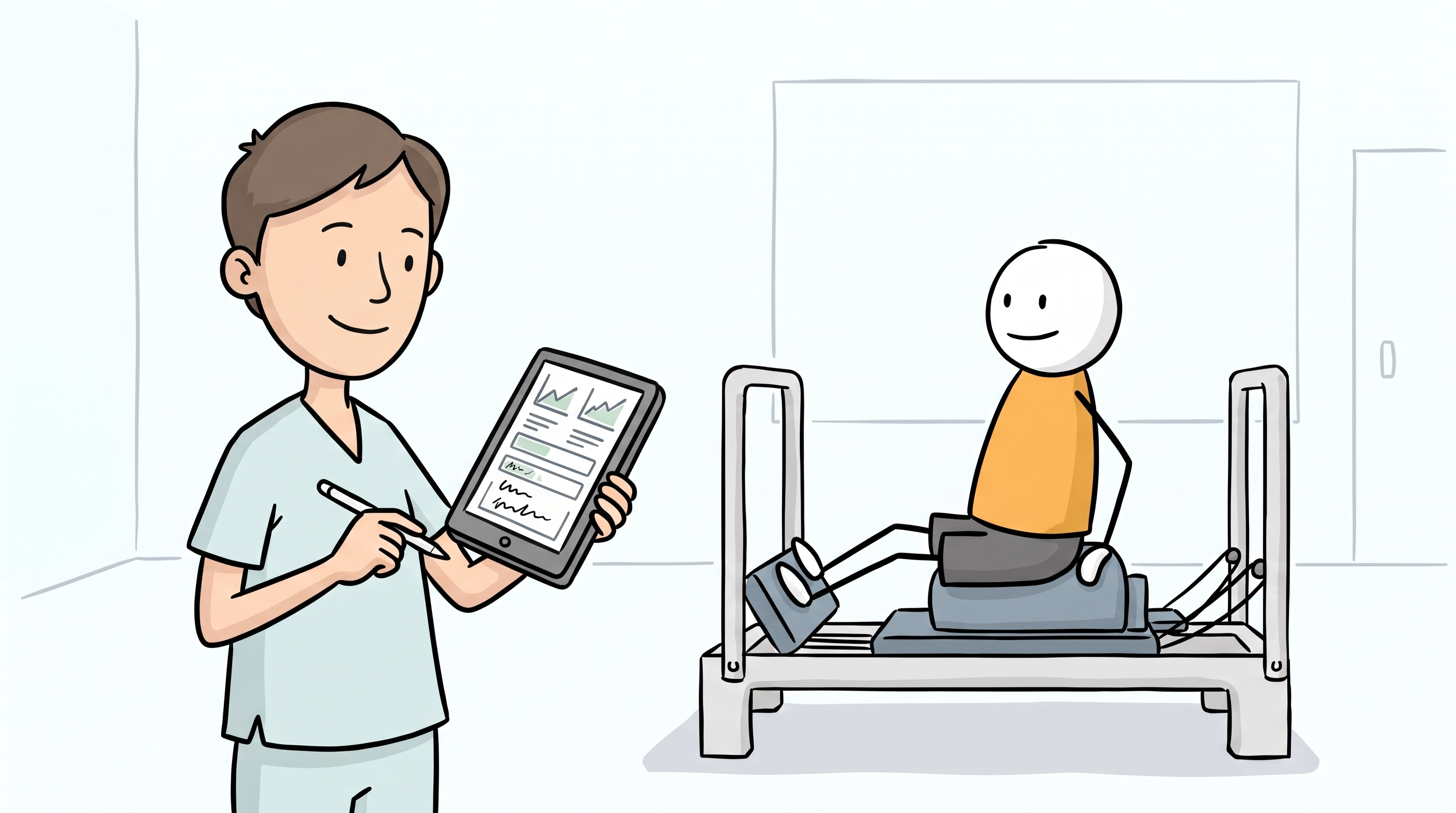
In many practices, training documentation in physiotherapy is written from memory at the end of the day: three sentences per appointment, exercise names without any loading details, the occasional note about reported pain. That neither meets the requirements for a comprehensible patient file nor provides the basis for sensibly steering loads over several weeks. At the same time, the reflex is understandable: additional documentation costs time, and time is often scarce in day-to-day practice.
The solution rarely lies in more documentation, but in a clearer distinction: what has to be evidenced, what is professionally relevant for steering treatment, and what is pure habit? Once you have sorted these three levels out properly, you will usually document more briefly and yet more robustly.
Three functions documentation can serve
Documentation is often treated as a single task, but in fact it serves three very different audiences:
- Legal and contractual evidence function. In Germany, the duty to document treatment follows from the treatment contract in the Bürgerliches Gesetzbuch (the German Civil Code, § 630f BGB); on top of that come the requirements set out in the contracts with the payers. Austria and Switzerland have their own professional and contractual rules. The specific requirements differ depending on the country and the care setting. In principle, documentation should be made promptly and comprehensibly; subsequent changes must remain identifiable in line with the applicable requirements.
- Professional steering function. Documented loading parameters help you to plan and justify progression in a comprehensible way. This applies particularly to progress across several prescriptions and to handovers between colleagues.
- Communication function. Brief reports to prescribing doctors, feedback to payers, handovers within the team and information for patients themselves all draw on the same source.
Problems usually arise when a documentation field was created for one of these purposes and remains useless for the other two. An exercise name without parameters is a typical example: it proves that something took place, but says nothing about the dosage.
Mandatory details: The documentary core of every session
The specific requirements differ depending on the country, the payer and the care setting. So always check the contracts and professional requirements that apply to you. Regardless of the respective requirements, the following details are typically relevant for comprehensible treatment documentation:
- Identification of the patient and allocation to the prescription or treatment assignment
- Date and duration of the session as well as the service provided, using the designation set out in the contract
- Name of the treating person, clearly attributable when there is a change within the team
- Findings and goals at the start of the treatment series as well as their adjustment over time
- Content of the session, that is, the measures carried out in sufficient detail
- Relevant reactions, anything conspicuous and deviations from the planned approach
- Information and consent, where required, as well as cancellations and discontinuations
"Sufficient detail" is the decisive point here. A professional colleague must be able to reconstruct from the file what was done, without asking you. "Strengthening lower extremity" does not achieve this. "Guided squat, bilateral, 3 sets, additional load documented, stopped at the patient's request after set 2 due to pain on loading" does.
Training documentation in physiotherapy: Additional data that help with training control
Beyond the mandatory details, the question arises as to which additional data are actually useful for therapeutic steering. This is where the professional added value is created, but it is also where most unnecessary work arises. A sensible rule of thumb: an additional field is only justified if you can name the decision you would make differently over the next few weeks as a result.
| Data field | What you actually need it for | Effort per session |
|---|---|---|
| Load, repetitions, sets | Comprehensible progression, load management over weeks | low, if previous values are visible |
| Perceived exertion (RPE 0–10 or Borg 6–20) | Dosage on days of varying form, comparison with objective load | very low, a single number |
| Reported pain during and after loading | Assessment of tolerance, justification for adjustments | very low |
| Range of motion or standardised functional test | Objectifying progress, basis for brief reports | medium, therefore only at defined time points |
| Patient-reported questionnaire scores | Comparison of function and subjective impairment | medium, can be collected outside the session |
| Adherence to the home programme | Explanation of absent progress, adjustment of volume | low, if the patient plays their part |
| Response to loading in the following 24 hours | Assessment of dosage over time, not within the session itself | low, asked at the start of the next session |
What matters is not the number of fields, but their repeatability. A range of motion measured monthly in an identical starting position and with the same measurement method carries more meaning than a weekly measurement with varying methodology. So agree within the team how measurements are taken, not just that they are taken.
Measurement points instead of continuous recording
Many practices fail because they try to record everything all the time. A framework with a few defined time points is more workable: a baseline assessment at the start of the series, an interim assessment around the halfway mark, a final assessment. Between these points, depending on the therapy goal, the loading parameters of the respective session plus exertion and pain ratings may be enough. This reduces the workload and at the same time makes progress easier to read, because the points of comparison are clearly defined.
What you can drop
Just as important as the question of what is missing is the question of what is being carried along unnecessarily. Typical candidates:
- Free-text fields that grew historically and contain the same information all over again
- Duplicate recording of the same detail in appointment management, treatment file and training plan
- Detailed descriptions of how an exercise is performed, which belong in a stored exercise description rather than in every session
- Rating scales that no one in the team applies consistently and whose values are therefore not comparable
- Figures collected because a system offers them, without any decision depending on them
A clean-up is particularly worthwhile before introducing new digital tools. If you simply carry existing redundancies over, you double the workload instead of reducing it.
Four levers to reduce the documentation workload
First: Place documentation within the session, not after it. A brief entry made directly during or after the exercise is usually faster and more reliable than reconstructing it later from memory. In practical terms: place the recording device or sheet where the training takes place, and capture the relevant details as directly as possible.
Second: Make previous values visible. If the last load, the last number of repetitions and the last exertion rating are immediately visible, documentation becomes a by-product of training control. Without that view, it becomes a pure box-ticking exercise.
Third: Involve patients. Repetition counts, exertion ratings and feedback on the home programme can partly be recorded by the people training themselves. These entries should then be reviewed therapeutically and, where required, documented accordingly. This can reduce the recording workload on the therapeutic side and involve patients more closely in documenting their own training. The professional assessment remains yours and must also be identifiable as your assessment.
Fourth: Standardise wherever standardisation is possible. Templates for common constellations, a closed exercise library with fixed naming, selection fields instead of free text for recurring details. Free text remains for the exceptional: deviations, reactions, decisions and the reasoning behind them.
Consider data protection and traceability from the outset
Health data are subject to particular requirements. Before introducing new ways of recording data, clarify where data are stored, who in the team has access, how corrections are logged and how long data are retained. If patients enter data themselves, that includes clear information about what happens with those entries. The traceability of changes is essential for the reliability of the documentation. For the specific legal assessment in your practice, expert advice is advisable; this article cannot replace it.
Implementation: An approach for the next four weeks
Do not start with the system, start with the content.
- Week 1 – Stocktaking. Take ten completed treatment series and check whether a colleague who was not involved in the treatment can follow the course of therapy from the file alone. Note where information is missing or remains unclear.
- Week 2 – Define the core fields. Define the mandatory documentation fields within the team and add a maximum of three to four additional fields that are genuinely relevant for therapeutic steering. Anything beyond that should only be recorded if it delivers concrete added value.
- Week 3 – Define the measurement convention. Set out on a single page which tests and scales are used, in which starting position measurements are taken, at which time points assessments take place and which units are used. These standards can at the same time serve as a basis for onboarding new staff.
- Week 4 – Trial run and time measurement. Test the new standard in day-to-day practice and take spot checks of how long documentation takes per session. Also check which fields are regularly left out and whether they are actually necessary or simply poorly integrated into the workflow.
The test of good training documentation is not its length, but whether the file makes it possible to follow why a particular load was chosen and how it was adjusted over the course of therapy.
Frequently asked questions
Which details must training documentation contain as a minimum?
The core includes allocation to the patient and to the prescription, the date, duration and service provided, the treating person, findings and goals, the measures carried out in comprehensible detail, as well as reactions, deviations, cancellations and any required consents. The exact requirements follow from the relevant professional law and the contracts with the payers and should be checked individually for each practice.
How detailed does exercise documentation have to be?
Detailed enough for a colleague unfamiliar with the case to reconstruct the session without having to ask. An exercise name alone is not enough for that. What works well is an unambiguous exercise designation from a fixed library plus loading parameters such as load, repetitions and sets. Detailed descriptions of how the exercise is performed belong once in the stored exercise description, not repeatedly in every single session.
May patients record training data themselves?
Self-recorded entries such as repetitions, exertion values or feedback on the home programme can usefully supplement the documentation and shift some of the recording workload. The professional assessment and the responsibility for the treatment file, however, remain therapeutic. What matters is clearly marking the origin of such entries, a therapeutic review and clear information about how the data are stored and used.
How can the documentation workload be reduced without a loss of quality?
Four levers are the most effective: document during the session rather than afterwards, make previous values immediately visible, use selection fields and templates for recurring details, and drop additional fields on which no decision depends. Objective measurements are placed at a few fixed time points instead of being collected continuously. Free text is reserved for deviations, reactions and reasoning.
Read more

Digital exercise therapy: Which metrics really hold up
Movement data is now generated almost as a by-product. What matters is which of it actually changes a therapeutic decision – and which only ties up storage space and analysis time in your practice.

Building self-pay services: A realistic path for small practices
How small practices can develop a viable second income stream – from choosing a target group to pricing and process planning, through to communication without sales pressure.
Reducing waiting times in physiotherapy: Planning rather than pace
How practices can shorten waiting times with a robust appointment grid, deliberate buffer times and complementary group sessions, without cutting treatment time.