Digital exercise therapy: Which metrics really hold up
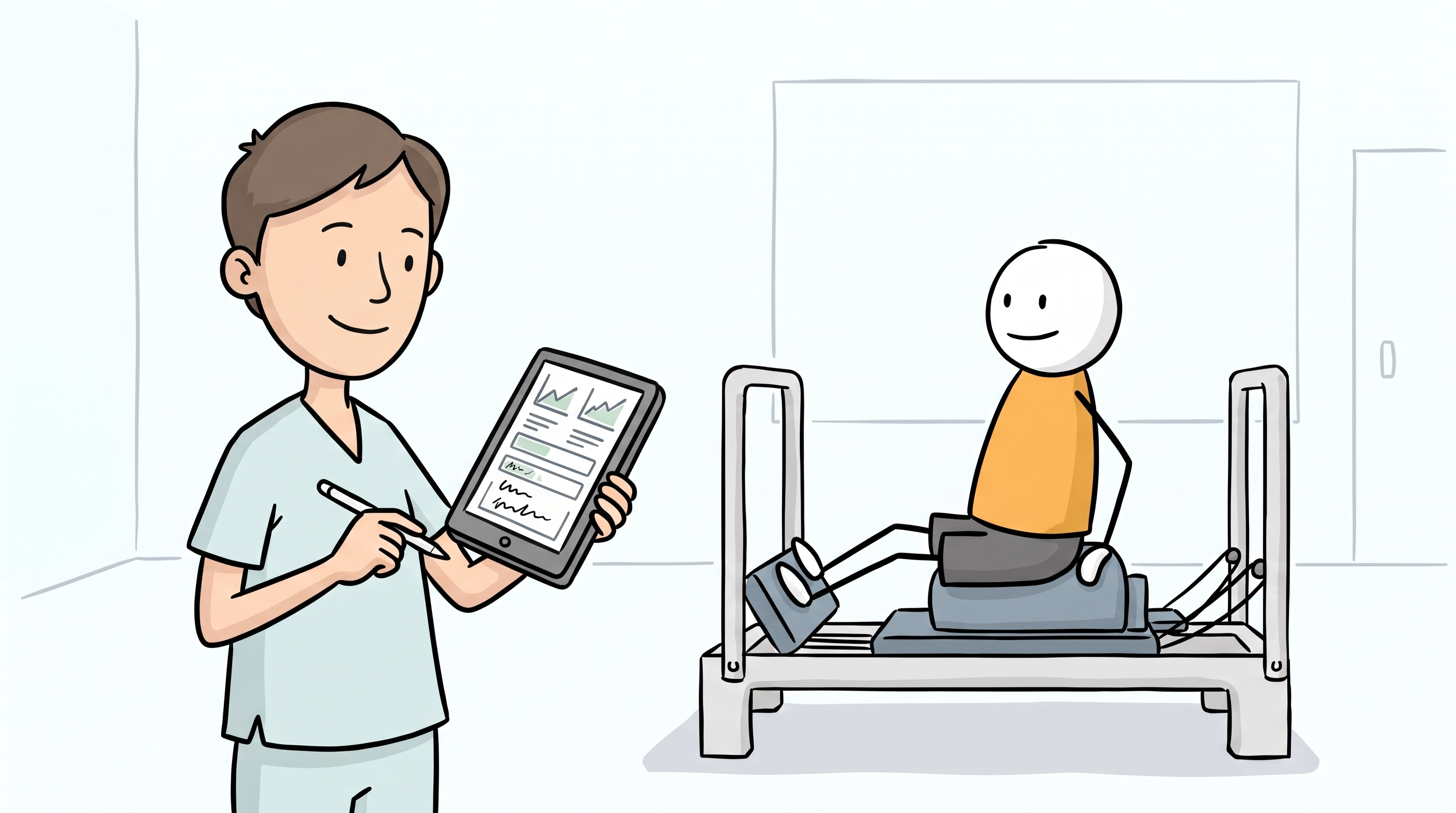
Movement data is now generated almost as a by-product. What matters is which of it actually changes a therapeutic decision – and which only ties up storage space and analysis time in your practice.

Sensors, cameras and apps can generate large volumes of data in exercise therapy. What matters, therefore, is not only what can be measured technically, but which metrics actually support therapeutic decisions. If you do not define that purpose in advance, you quickly end up collecting values that are barely used in day-to-day practice and that create additional analysis work.
What devices actually capture during movement
Technically, the common methods can be grouped into a few basic categories. Camera-based systems capture movements and can derive from them, for example, joint positions, movement paths and the time course of a repetition. Inertial sensors worn on the body measure acceleration and rate of rotation, allowing conclusions to be drawn about range of motion or speed. Force plates and instrumented training equipment can record forces, moments or load distribution. Applications based solely on self-reporting, by contrast, do not capture movement directly but record what patients tell them.
An important distinction here is between directly measured values and values derived from them. A joint angle calculated from a digital skeletal model is a model-based estimate and cannot simply be equated with a goniometric measurement. A training load calculated from, say, the number of repetitions and the resistance is likewise based on defined assumptions. For tracking progress over time, such values can nevertheless be helpful, provided that measurement conditions and procedures are sufficiently standardised.
Metrics that hold up in daily practice
A metric is particularly useful in daily practice if it is suitable for its intended purpose, can be recorded reproducibly under comparable conditions, reflects relevant changes, and allows a concrete therapeutic decision to be derived from its trajectory. Applied to this grid, fewer figures usually remain – but the ones that do have a clear benefit.
- Training time completed and frequency: easily recorded metrics that indicate training volume and regularity. Changes can be a reason to discuss possible obstacles or the need for adjustment.
- Repetitions with accepted movement quality: in systems with defined criteria, the proportion of accepted repetitions can provide additional clues about how a movement is being performed. What matters is how transparently and reliably those criteria are recorded.
- Range of motion in a standardised starting position: can be meaningful over time if position, camera distance or sensor placement remain comparable. Without standardised conditions, changes quickly lose their significance.
- Side-to-side differences: can be relevant for certain questions, but should only be interpreted using sufficiently reliable and standardised measurement methods. Small differences are not automatically clinically meaningful.
- Load progression across several sessions: resistance, number of repetitions, hold time or other load parameters over time can help to justify adjustments to the training plan in a comprehensible way.
- Perceived exertion and reported symptoms after the session: not a classic device measurement, but important context for assessing load and tolerability.
What many of these metrics have in common is that their trajectory is often more meaningful than an isolated single value. What counts, therefore, is less any single number than the question of how it develops over several sessions under comparable conditions.
Numbers that mainly create work
Measurements without a clearly defined purpose can create additional work without meaningfully supporting therapeutic decisions. These may include high-resolution joint angle curves without standardised starting conditions, calorie estimates, composite scores without a comprehensible calculation, or comparisons with reference groups that do not fit. Highly differentiated symmetry indices, too, are only helpful if their measurement accuracy is sufficient to distinguish relevant changes from normal fluctuation.
A practical test helps: state in advance which change in a value should lead to which action. If no concrete consequence can be derived from a figure, its benefit for training management is limited. It may still serve another purpose – for example, providing understandable feedback to patients. These different functions should, however, be deliberately kept separate.
| Purpose | Suitable metrics | Typical mistake |
|---|---|---|
| Managing load | progression, movement quality, frequency | decisions based on individual daily values |
| Feedback to patients | progress curves, goals achieved | raw data without understandable context |
| Documentation | date, content, dosage, relevant deviations | reconstructing after the fact from scattered notes |
| Practice organisation | no-show rate, gaps in the schedule, capacity utilisation | figures without a clear purpose or ownership |
From measurement to decision
Data only becomes useful once a comprehensible consequence follows from it. Several factors interact here. Real-time feedback, for example, makes it possible to adjust a movement while it is still being performed. How often and at what point feedback is useful, however, depends on the training goal, the task and the prerequisites of the person training.
Comprehensibility is just as important. Feedback that patients can immediately understand and act on serves a different function from a measurement that first has to be interpreted therapeutically. Then there is the question of thresholds: without criteria defined in advance for when an adjustment should be made, there is a risk that figures are recorded but not used consistently.
For daily practice it can therefore make sense to define a small number of central control metrics per treatment goal and to define their meaning unambiguously within the team. An example: if the movement quality of an exercise remains clearly below the agreed target range over several sessions, the exercise can first be simplified or adapted before the load is increased. Rules of this kind make a consistent approach easier, even when responsibility for a patient changes within the team.
How Pixformance connects measurement and management in digital exercise therapy
One challenge in daily practice is often to connect measurement, feedback and documentation in a sensible way. The station from Pixformance addresses exactly this point. A camera captures 25 joint points in real time during training. A virtual trainer demonstrates each exercise on the display and provides visual and text-based feedback while the movement is being performed. Feedback thus happens directly during training, rather than only in a follow-up review conversation.
Training data is documented automatically in the process. Whether transfer into other documentation systems is also required depends on the individual practice workflow.
According to the manufacturer, up to four people can train at one station at the same time. Depending on the supervision concept, the patient group and the available space, this can make it possible to supervise several people in parallel. This approach can be combined with considerations about appointment and capacity planning as described in the article Reducing waiting times in physiotherapy: Planning instead of speed.
Pixformance has been examined in various clinical and scientific projects. These include research into technology-supported exercise therapy in different patient groups as well as the European research project FORTEe on exercise therapy in paediatric oncology. Studies of this kind should always be considered in the context of their study design, their target group and their specific research question.
| Criterion | Pixformance Station | Conventional strength equipment without automated feedback | One-to-one supervision by a therapist | Exercise sheets and home exercise apps |
|---|---|---|---|---|
| Feedback during performance | automated visual and text-based feedback based on movement capture | usually no automated movement feedback | individual feedback directly from the treating person | depends on the application, in some cases no immediate feedback |
| Supervision | parallel training of several people possible | depends on space, equipment and supervision concept | individual one-to-one supervision | often performed independently |
| Training documentation | training data is recorded automatically | depends on the individual device and practice process | therapeutic documentation usually required | depends on the application |
| Staff input | depends on patient group and supervision concept | depends on the form of training and the need for supervision | high direct staff commitment per appointment | low direct supervision requirement possible |
| Use in additional training services | possible, depending on the practice concept | possible | possible, but with direct staff commitment | mainly as a supplement between supervised appointments |
| Feedback on progress | training and progress data can be made visible immediately | depends on device and documentation | individual therapeutic feedback | depends on the application and data capture |
| Scientific investigation | examined in various clinical and scientific projects | depends on the individual device and field of use | broad evidence base for physiotherapeutic interventions, depending on indication and method | varies widely by application |
| Cost structure | leasing or purchase depending on the contract model | depends on the type and specification of the equipment | ongoing staff costs | varies by application |
Digital systems do not replace therapeutic judgement. In complex cases, in manual examinations, or in situations where individual assessment and immediate therapeutic decisions are paramount, personal care remains central. Digital exercise therapy can above all provide support where structured, repeatable exercises, immediate feedback and comprehensible progress monitoring are to be sensibly combined.
Putting it into practice
Do not start with the technology, but with your most common treatment and training goals. For two or three of them, define which metrics are genuinely relevant for therapeutic management, under which conditions they are recorded, and which changes should trigger an adjustment to the plan. Keep these rules as concise as possible.
In a second step, check which of this data is generated without any additional effort, or with only minimal effort. The more a figure requires additional manual documentation, the more important the question of its actual benefit becomes.
In a third step, the team can review at regular intervals whether the values recorded have actually contributed to therapeutic decisions. Figures that provide no relevant information over a longer period, or that do not support any concrete action, should be critically questioned and, if necessary, dropped.
What matters, then, is not the volume of data collected but its consistent use. A few meaningful metrics can be more helpful in daily practice than a large number of values from which no concrete decision follows.
Frequently asked questions
Which metrics should be recorded as a minimum in digital exercise therapy?
A small, stable core makes sense: training frequency, the proportion of correctly performed repetitions, load progression across several sessions, and perceived exertion after the session. Range of motion and side-to-side differences can serve as additions, provided the starting position remains standardised. What is decisive is that a concrete action is defined in advance for every metric.
Why are single values from movement analyses often of little significance?
Camera-based or sensor-supported values are frequently derived metrics, in other words estimates from a model. They fluctuate with position, clothing, daily form and measurement set-up. Across several sessions, systematic deviations largely cancel each other out, so the direction of the trajectory is more robust than a single absolute value. For training management, therefore, it is the trend that counts.
How does the Pixformance Station support analysis in daily practice?
The station uses a camera with a depth sensor to capture 25 joint points in real time and provides visual and text-based corrective feedback via the display while the movement is being performed. Training documentation runs automatically alongside, so there is no need to record anything afterwards. Up to four people can train at one station at the same time, which makes it possible to supervise several patients in parallel.
Does digital exercise therapy replace personal treatment?
No. With complex findings, in manual therapy and wherever palpation and individual adjustment carry the decision, personal one-to-one treatment remains professionally superior. Digital systems play to their strengths in structured, repeatable movement work with progress monitoring, and there they create windows of time that can be used for individual treatment.
Read more

Building self-pay services: A realistic path for small practices
How small practices can develop a viable second income stream – from choosing a target group to pricing and process planning, through to communication without sales pressure.
Training documentation in physiotherapy: What really counts?
Between mandatory record-keeping and training control: a structured look at which details belong in the patient file, which data support therapeutic decisions and which documentation fields you can do without.

Reducing waiting times in physiotherapy: Planning rather than pace
How practices can shorten waiting times with a robust appointment grid, deliberate buffer times and complementary group sessions, without cutting treatment time.