Building self-pay services: A realistic path for small practices
How small practices can develop a viable second income stream – from choosing a target group to pricing and process planning, through to communication without sales pressure.
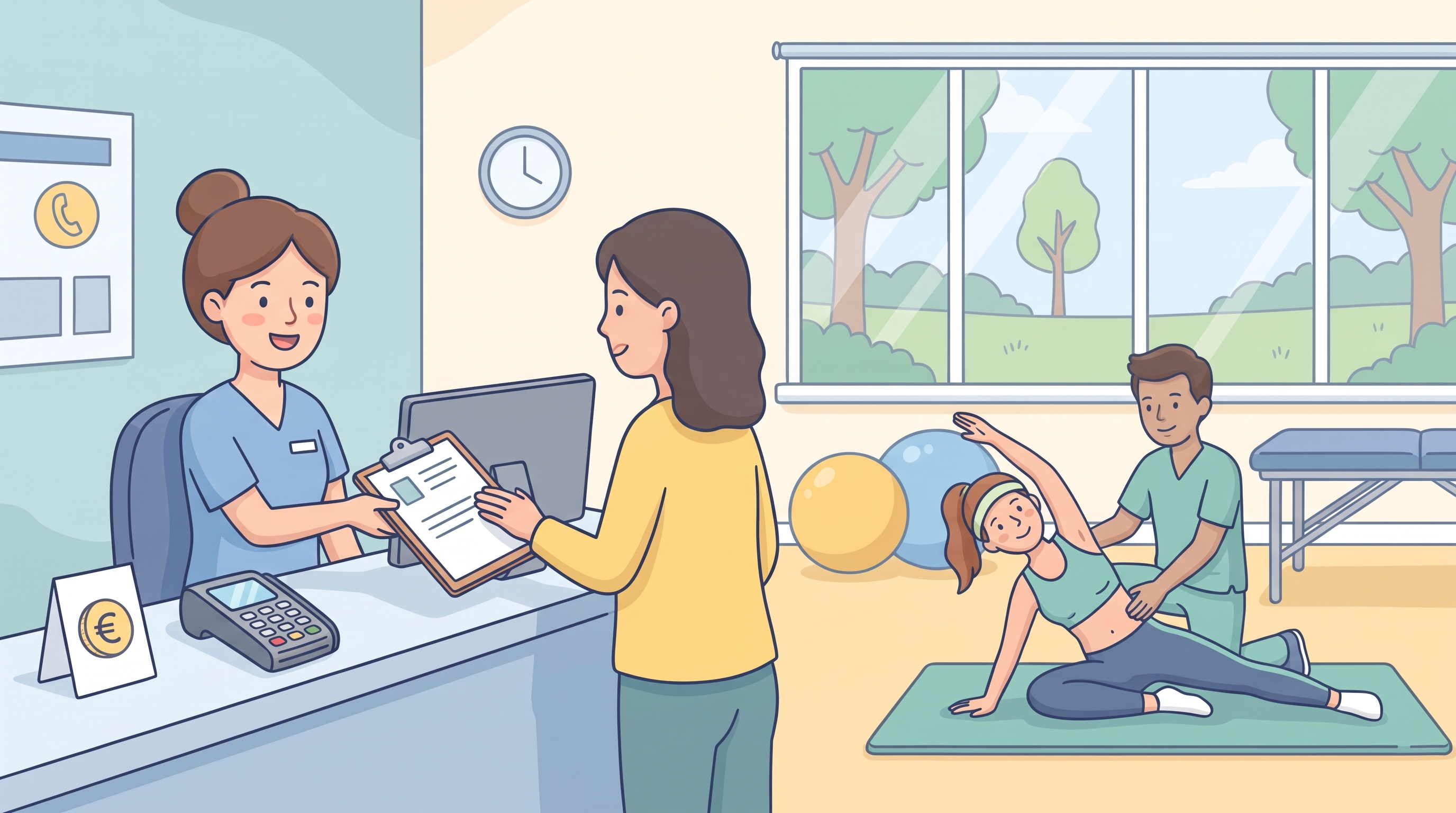
The appointment book is full, yet the fee per treatment session remains limited, while rising costs squeeze your financial room for manoeuvre even further. Many owners therefore consider self-pay services, but put the plan off because it is unclear where to start. This is precisely where a structured approach pays off: a viable self-pay service does not come from a good idea alone, but from a series of concrete decisions about target group, price, process and communication.
Why implementation is often harder than the idea
In conversations with practice managers, the same ideas come up again and again: back training in small groups, follow-up care after the prescription ends, performance diagnostics, corporate offerings, courses for older people. The ideas are rarely the problem. Things fall down on three other points.
First, there is no decision about who the service is meant for. A service "for everyone who wants to do something for their back" cannot be communicated, because nobody feels addressed. Second, the price is set by gut feeling, usually too low, because you want to avoid rejection. Third, there is no defined process. As a result, delivery depends on individual people and collapses as soon as someone is unavailable.
On top of this comes a cultural hurdle: many therapists have learned to talk about indications, not about services that people buy out of their own interest. This change of perspective is a matter of practice and can be trained.
Sharpening the target group: From the idea to a concrete trigger
Instead of starting with the service, it is better to start with a trigger. A trigger is a situation in which a person is willing, of their own accord, to invest money and time. Typical triggers around a therapy practice:
- The prescription ends, but capacity is not yet where it needs to be for work or sport.
- An operation is coming up, and the waiting time is to be used for preparation.
- A return to sport or exercise after a longer break is being planned.
- Recurring complaints lead someone to look for regular, guided exercise.
- An employer wants to organise an exercise offering for a particular department.
Test every trigger against three questions: Do people with this situation come into your practice regularly? Can you deliver the service with your existing staff and rooms? And is the trigger clear enough that you can describe it in one sentence that a patient immediately understands?
A single trigger is enough to start with. If you introduce three offerings at once, you spread attention and organisational capacity thin and will not be able to judge later what actually worked.
Calculate the price rather than estimating it
A price based purely on feel will almost always be too low. Instead, build up from your costs. The components are manageable:
- Staff costs for face-to-face time, including employer contributions
- Preparation, documentation and follow-up time
- Room and equipment costs for the time slot occupied
- Share of administration, scheduling, software and insurance
- Calculated no-show rate for group offerings and short-notice cancellations
- Entrepreneurial profit margin and VAT, if the service is taxable
The last point deserves attention: whether a service is VAT-exempt depends on whether it counts as medical treatment. Prevention and fitness offerings without a therapeutic basis are treated differently from services with a medical basis. Clarify this with your tax adviser before setting your price, otherwise you will later have to revise a price downwards that you have already communicated gross.
A simple comparison helps with the decision between one-to-one and group formats:
| Criterion | One-to-one service | Small group |
|---|---|---|
| Revenue per unit of time | depends on the individual price | several participants per slot |
| Price acceptance | higher individual price required | lower price per person |
| Organisational effort | low | scheduling, group size, no-shows |
| Staff commitment | one professional throughout | one professional for several people |
| Dependence on utilisation | low | high, set a lower limit |
For groups, set a minimum number of participants below which a session does not go ahead. Without this limit, you will permanently subsidise the offering with your team's time.
On discounts and package prices: packages make sense if they reflect a structured programme, for example a series of eight sessions with an initial and a final appointment. They are risky if they are merely a price reduction. Also consider how you handle unused sessions and validity periods, and put this in writing.
Define the process so that it works without you
For a self-pay service to work reliably in day-to-day practice, the organisational process also needs to be clearly defined. That involves more than the content of the training session. A one-page process sheet with these stages is useful:
- First contact: Who takes enquiries, what information is recorded, which documents are sent out in advance?
- Initial appointment: History taking, clarifying goals, baseline measurements, explaining the scope and limits of the offering, written agreement.
- Delivery: Structure of the sessions, documentation standard, how to handle changes in symptoms, defined criteria for consultation or discontinuation.
- Progress review: Fixed points for repeating the baseline measurements and adjusting the load.
- Conclusion: Feedback to participants, recommendation for the period afterwards, decision on extension.
- Billing: Timing, payment method, handling of cancellations and cancellation fees.
Document self-pay services with the same care as prescribed treatments. This serves not only transparency towards participants, but also internal handovers. How to set up such a standard is described in the article Training documentation in physiotherapy: What really counts.
A clear distinction is important: a prevention or training offering does not replace treatment or medical assessment. Set out in writing the situations in which you refer participants to a doctor, and communicate this at the initial appointment.
Plan scheduling and room use realistically
Self-pay services compete with the core business for rooms and time. Wherever possible, place slots at times when prescription-based work is quieter, such as early morning or later in the evening. Block these times firmly in the calendar rather than allocating them "as and when". Otherwise they will be sacrificed at the first bottleneck, and the offering will disappear within a few weeks.
Communication without sales pressure
Most enquiries do not come from adverts, but from conversations in the practice. The timing is crucial: the sensible moment is not the last minute of the last treatment, but two or three sessions earlier, when the further course of care is being discussed.
Three elements keep such a conversation matter-of-fact:
- Name the observation: What has changed, what is still open?
- Describe the option: What does the offering include, how long does it take, what does it cost?
- Leave the decision open: Hand over an information sheet, allow time to think it over, no follow-up question in the same breath.
A standardised information sheet with content, scope, price, cancellation policy and contact person is helpful. That way every colleague says the same thing, and questions about price do not lead to improvised answers. Train the team on two or three standard situations through role play; it costs half a team meeting and prevents a great deal of uncertainty.
Externally, you promote the offering via your own website, a notice in the practice, your newsletter if you have one, and your contacts with referring practices. Describe the trigger and the process, not the method. Be restrained in claims about effects and stick to the requirements of the Heilmittelwerberecht (German law on advertising in the healthcare sector): describe what you do, not what the outcome will be.
The first twelve weeks in day-to-day practice
Treat the launch as a test phase with a fixed end date. A realistic sequence:
- Weeks 1 and 2: Define the trigger, write the process sheet and information sheet, calculate the price, clarify the tax classification.
- Week 3: Brief the team, practise conversation situations, block slots firmly in the calendar, create a documentation template.
- Weeks 4 to 11: Run the offering, note every enquiry, including those declined, and record the reason.
- Week 12: Evaluation based on a handful of key figures.
Four figures are enough for the evaluation: number of enquiries, number of sign-ups, actual hourly revenue after deducting no-shows, and the time spent on organisation. Add two qualitative questions for the team: Where was the conversation uncomfortable? And what did participants not understand?
If the numbers are weak, a differentiated analysis of the causes is worthwhile. Alongside the price, a target group that is too vague, poor timing of the conversation or an overly elaborate process may also play a role. Change only one variable per cycle, otherwise after the next quarter you will again not know what made the difference.
If an offering does not carry itself after the test phase, it may make sense to discontinue it or to adapt it fundamentally. The processes, costing bases and conversation guides you have developed can be reused for future offerings.
Frequently asked questions
How do I find the right price for a self-pay service?
Calculate upwards from your costs: staff time including employer contributions, preparation and documentation, share of room and equipment, administration overhead, a calculated no-show rate as well as profit margin and, where applicable, VAT. Comparisons with other practices serve only as a plausibility check. A price that is too low is hard to correct later and puts a permanent strain on the core business.
Are self-pay services in physiotherapy exempt from VAT?
That depends on the nature of the service. Tax exemptions apply to medical treatment, while general prevention, fitness or wellness offerings without a therapeutic basis may be classified differently. The distinction is not trivial in individual cases. Clarify the classification with your tax adviser before setting the price and before publishing it, to avoid later back payments and price corrections.
Which offering should small practices start with?
With a single, clearly defined trigger that occurs regularly in your practice, such as the transition after a prescription has run out. One offering can be organised, communicated and evaluated. Several formats at once tie up too much attention and make it impossible to see which element actually worked.
How do I approach patients without seeming pushy?
Choose a moment two or three sessions before the end, when the further course of care is being discussed anyway. State the current status and the goal that is still open in a matter-of-fact way, describe the scope, duration and price of the offering, and hand over an information sheet. The decision stays open, with no follow-up question in the same conversation.
Read more

Digital exercise therapy: Which metrics really hold up
Movement data is now generated almost as a by-product. What matters is which of it actually changes a therapeutic decision – and which only ties up storage space and analysis time in your practice.
Training documentation in physiotherapy: What really counts?
Between mandatory record-keeping and training control: a structured look at which details belong in the patient file, which data support therapeutic decisions and which documentation fields you can do without.
Reducing waiting times in physiotherapy: Planning rather than pace
How practices can shorten waiting times with a robust appointment grid, deliberate buffer times and complementary group sessions, without cutting treatment time.