Training equipment in physiotherapy: Calculating the costs realistically
A clear calculation framework for your training area: record fixed costs properly, estimate occupied hours honestly, assess how much staff time is tied up, and derive the utilisation level you need.
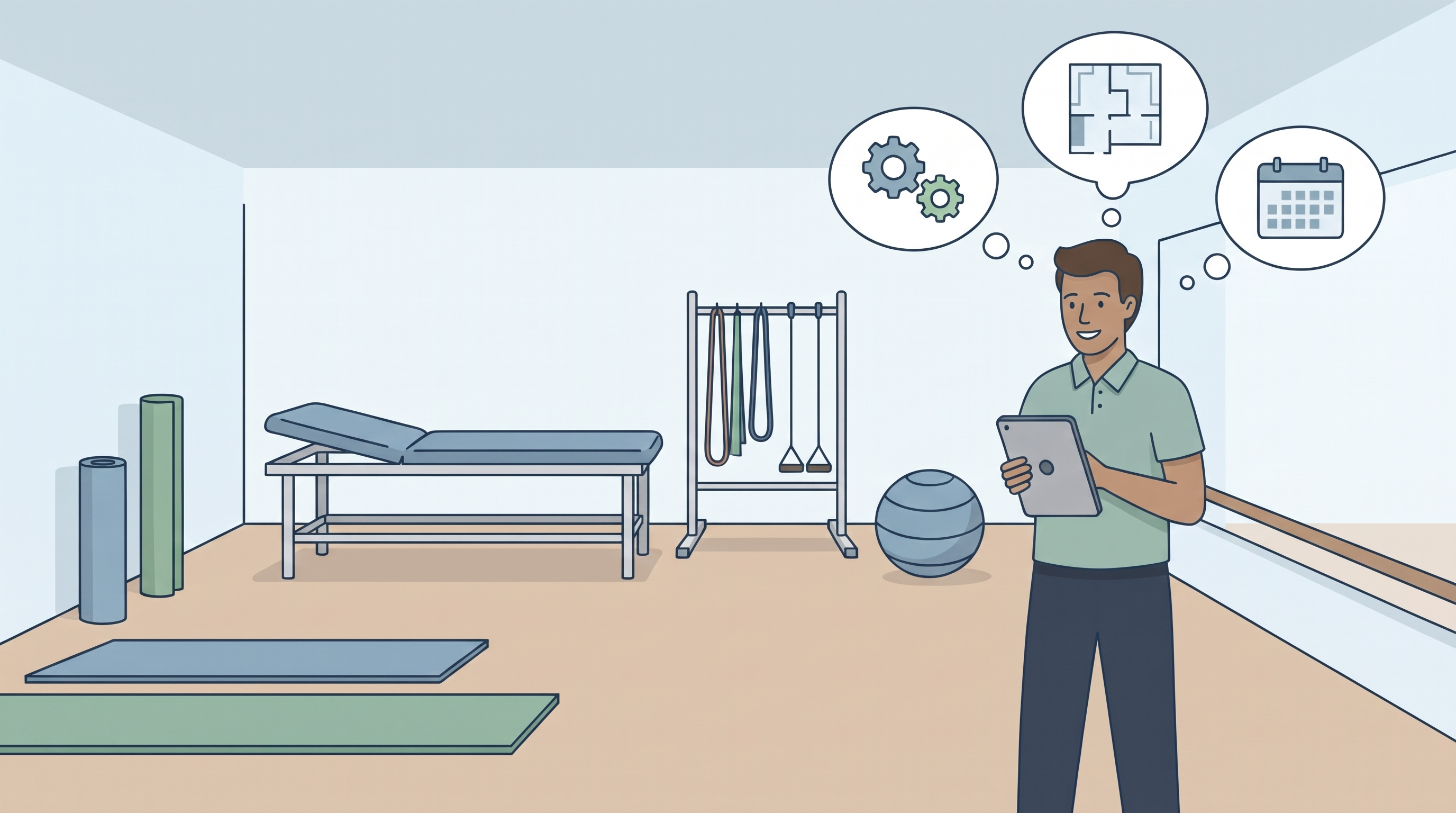
Many investment decisions about the training area start with the purchase or leasing price. For a robust calculation, however, that figure alone is not enough. What matters is the total monthly cost involved, how intensively the area is actually used and what revenue is set against those costs.
A simple profitability calculation can help make different equipment, financing options and training concepts comparable – without focusing solely on the quoted price.
What training equipment in physiotherapy really costs
The purchase or leasing price is only part of the total cost. Depending on the concept, there are also premises, software, service, maintenance, staff and other ongoing expenses.
Before making an investment decision, it is therefore worth drawing up your own cost overview first:
| Cost block | Typical classification | What to watch out for in your calculation |
|---|---|---|
| Purchase or financing | fixed | Purchase price, leasing or financing instalment, term and possible residual values |
| Premises and utilities | fixed | Proportional rent, electricity, heating, cleaning |
| Staff | depends on the supervision model | Planned supervision times and additional staff hours |
| Software and licences | fixed or usage-based | Record ongoing fees separately from the equipment price |
| Maintenance, service and repairs | fixed or variable | Scope of services, response times and possible additional costs |
| Onboarding and training | one-off and potentially recurring | Training effort at introduction and when staff change |
| Insurance and inspections | largely fixed | Required inspections and ongoing insurance premiums |
| Marketing the service | depends on the concept | Additional costs for attracting self-payers or participants |
For the calculation that follows, the distinction between fixed and variable costs is important. Fixed costs arise regardless of whether the training area is being used to capacity. Variable costs, by contrast, rise with actual usage.
With staff, take particular care not to record costs twice. If a member of staff is scheduled for fixed times in the training area, for example, that staff time can be included as a monthly cost block. If, on the other hand, staff costs only arise in line with actual usage, they can be entered as variable costs per training hour.
Utilisation as the central factor in the calculation
The monthly fixed costs of a training area do not automatically change because the area is used more or less often. What is decisive for profitability is therefore how many usable training hours are actually taken up.
A realistic estimate should not start from the theoretical maximum utilisation, but from your own practice data.
Useful questions are:
- Which times of day are consistently well used?
- At what times is there spare capacity?
- How many hours is the area genuinely available once breaks, cleaning and organisational buffer times have been deducted?
- What losses from cancellations or illness typically occur?
- Are there seasonal differences?
- How does demand for new services typically develop in the first few months?
From this information you can derive a realistic range. For the investment decision, it is advisable not to calculate only with an optimal scenario, but also with a cautious utilisation assumption.
The article Reducing waiting times in physiotherapy: Planning instead of pace describes how scheduling and utilisation can be structured in principle.
Staff deployment as part of the profitability calculation
Alongside premises and technology, staff deployment can account for a considerable share of the ongoing costs of a training area. What matters, therefore, is the supervision concept you plan to use.
A training offering with continuous individual supervision has a different cost structure from an area in which patients can carry out defined training content more independently after therapeutic instruction.
For the calculation, the following questions, among others, should be answered:
- How many staff hours per week are planned for the training area?
- Which tasks directly require a therapist?
- Which processes can be standardised organisationally or supported by technology?
- What supervision requirements arise from the particular patient group?
- Does the new service create additional staffing needs, or is existing working time simply deployed differently?
The supervision structure should not be derived from a desired level of profitability. It has to suit the respective training offering, the patient group and the applicable requirements from a professional standpoint.
The article on staff shortages in physiotherapy describes how tasks can be differentiated in day-to-day practice. Additional figures on the debate around capacity and therapist time can also be found in the Therapy Efficiency Report 2026.
The revenue side: Prescribed services, self-payers and mixed calculations
The expected revenue has to be set against the costs. It is not enough simply to look at the price of a single appointment. What matters is the actual economic contribution of an occupied training hour or of the respective offering.
Depending on the practice, different areas may come together:
- prescribed services
- supplementary self-pay services
- prevention or aftercare offerings
- fixed training programmes
- other privately funded services
With prescribed services, remuneration and the scope of services are largely predetermined. With self-pay services there is more scope to shape price, duration and the structure of the offering. At the same time, demand, marketing and organisational effort have to be taken into account.
When building up a self-pay area, a clearly defined offering is therefore usually easier to cost than a completely open training model. More detailed planning is described in the article Building up self-pay services: A realistic path for small practices.
Calculating break-even: A simple framework
A simplified break-even calculation can make different investments comparable. It does not replace tax or financial advice, but it creates a common basis for the decision.
1. Determine monthly fixed costs
Add up all costs that arise regardless of actual usage. These may include:
- financing or depreciation
- proportional premises costs
- software and licences
- service contracts
- insurance
- firmly scheduled staff time
2. Determine usable capacity
Work out how many training hours or training-station hours are realistically available per month.
For a rough monthly calculation, the hours available per week can be multiplied by around 4.33.
What matters, however, is not the theoretical capacity but the capacity that can actually be used under realistic practice conditions.
3. Apply a realistic utilisation rate
Calculate at least three scenarios:
- cautious utilisation
- medium utilisation
- high utilisation
The assumptions should wherever possible come from existing appointment and usage data, and not exclusively from a supplier's forecasts.
4. Determine the revenue per occupied unit
Calculate the average revenue associated with one occupied training hour or training-station hour.
Where offerings differ, you can calculate them separately first and then form a weighted average.
5. Deduct variable costs
From this revenue, deduct the costs that genuinely arise from additional usage.
The remaining amount is the contribution margin per occupied unit.
Important: staff already accounted for as a monthly fixed cost block must not be deducted in full again at this point.
6. Calculate the break-even occupancy
A simplified formula is:
Monthly fixed costs ÷ contribution margin per occupied unit = occupancy needed to break even
The result shows how many occupied hours or training-station hours per month are required for the ongoing costs to be covered.
If this figure is very close to the maximum realistically available capacity, the model is sensitive to cancellations and fluctuations. If break-even lies well below that level, there is more room for a start-up phase, seasonal changes or temporarily weaker demand.
Leasing or buying: What influences the decision
Whether purchase, leasing or another form of financing makes more sense does not depend on total costs alone. Liquidity, contract term and predictability also play a role.
Check in particular:
- Liquidity: How heavily does a direct purchase draw on your available financial reserves?
- Predictability: How do the monthly costs develop over the term of the contract?
- Term and useful life: Does the financing period match the expected period of use of the system?
- Scope of service: Which services for maintenance, support or software are already included?
- Additional costs: What costs can arise on top of the monthly instalment?
- End of contract: What purchase, return or extension options are available?
Tax and accounting implications should be clarified with your tax adviser. For the operational profitability calculation, what matters first is the actual monthly payment and cost burden that arises.
How digital training systems factor into the calculation
Digital training systems differ in their cost structure in some respects from conventional training equipment. Alongside the hardware, software, digital training control, documentation and support may form part of the respective offering.
One example is the Pixformance Station. This digital training and therapy system works with an integrated camera and a virtual trainer. While exercises are being performed, movements are captured and visual as well as text-based feedback is given. Training data is documented automatically and can be viewed via the online platform.
For the profitability calculation, these functions should not be converted wholesale into an expected "time saving". It makes more sense to examine specifically which processes actually change in your own practice:
- How does the effort for exercise instruction change?
- Which training data is captured automatically?
- Which manual documentation is still required?
- How much therapeutic supervision is necessary for the respective patient group?
- Which additional services can be delivered organisationally with the system?
- How does actual usage develop after introduction?
Pixformance currently quotes financing options from 220 euros per month. For your calculation, however, you should consider not only this instalment but the specific overall offer, including the contract term, the scope of services and possible further costs.
Automated training documentation can, for example, reduce the effort involved in manual recording. Whether and to what extent this actually frees up staff time should be measured against your own processes rather than assumed across the board.
The article Digital movement therapy: Which measurements really hold up describes which training data is genuinely relevant for therapeutic decision-making. Further guidance on documentation can be found in the article Training documentation in physiotherapy: What really counts?.
Implementation: Four steps to a basis for decision-making
Before you assess an investment, replace as many assumptions as possible with data from your own practice.
- Review utilisation: Analyse the actual use of existing training areas over a sufficiently long period and look at different times of day separately.
- Record costs in full: Bring together premises, staff, equipment, software, service and other ongoing costs in a single overview.
- Make offers comparable: Transfer different purchase, leasing or financing offers into the same cost structure. This allows you to compare monthly instalment, contract term and additional services.
- Calculate several scenarios: Work out a cautious, a medium and a higher utilisation rate and check in each case when break-even is reached.
What matters is not whether an investment looks profitable under optimal conditions. What is relevant is how robust the calculation remains in the face of a slower start-up phase, cancellations and fluctuating demand.
After introduction, actual usage should be compared regularly with the original assumptions. This shows whether utilisation, costs and revenue match the plan – and where adjustments are needed.
Frequently asked questions
Which figure determines whether a training area is profitable?
The central figure is the break-even occupancy: monthly fixed costs divided by the contribution margin per occupied hour of floor space. It shows how many hours per month actually have to be used. Compare this figure with the hours realistically available. The smaller the gap, the more vulnerable the investment is to cancellations and seasonal fluctuations.
Why are staff costs more important than the equipment price?
In most practices, supervision on the training area ties up more money than the technology. The decisive factor is how many people a qualified member of staff can supervise at the same time while remaining professionally defensible. If that number doubles, the proportional staff costs per station and hour are halved. The equipment price, by contrast, remains a constant, predictable fixed cost line.
What does getting started with Pixformance cost?
According to the manufacturer's fact sheet, entry starts at €220 per month on a lease, subject to external approval. That amount belongs in the monthly fixed cost line of your calculation. On top of that come the share of premises costs, staff time, cleaning and insurance. Only the sum of these items, divided by the occupied hours, gives the actual cost per training hour.
Leasing or buying – which makes more sense for a practice?
That depends on liquidity and planning horizon, not on a general rule. Leasing keeps equity free and provides a constant monthly instalment that can be entered directly into the fixed cost calculation. A purchase can be cheaper where the period of use is long. Tax and accounting effects should be clarified with your tax adviser in advance.
Read more

Staff shortages in physiotherapy: Redistributing tasks
When job adverts come to nothing, it pays to look at how tasks are distributed: which activities genuinely require therapeutic qualifications, and where processes and technology free up capacity.

Staff shortage in physiotherapy: Figures and ways out
The Therapy Efficiency Report 2026 shows how much therapist time goes into tasks that can be standardised – and how practices can gain capacity without hiring additional staff.

Building self-pay services: A realistic path for small practices
How small practices can develop a viable second income stream – from choosing a target group to pricing and process planning, through to communication without sales pressure.