Fall prevention training for seniors: Structure and progress monitoring
How to build up balance and strength training for older patients in a structured way, manage it safely in a group setting and document it with transparent observation metrics.
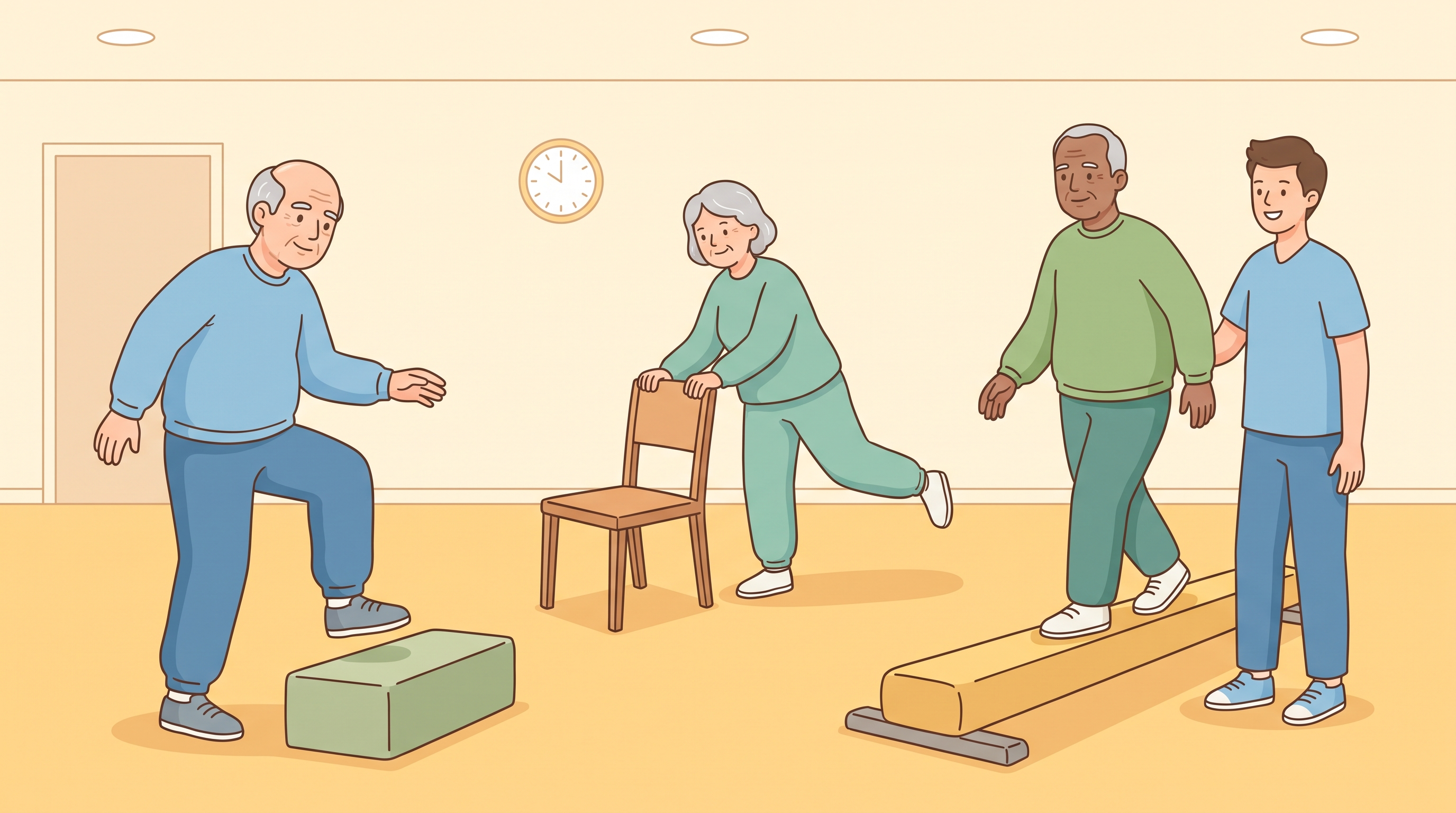
In geriatric rehabilitation, two requirements meet that often block each other in everyday practice: the training has to be demanding enough for balance and strength to change at all, and at the same time it has to be safe. Anyone offering fall prevention training for seniors therefore regularly faces the question of how to increase the load without losing oversight of an entire group. On top of that, progress has to be documented over weeks – in a way that is transparent for the team, for payers and for the patients themselves.
Why a structured build-up of load is necessary
Balance is not a quality you train in general terms, but an interplay of sensory processing, trunk and leg strength, reaction speed and movement experience. A programme that consists only of standing quietly on a soft mat reaches these components only partially. Equally unhelpful is a programme that sets complex tasks too early and thereby creates insecurity.
In practice, a build-up in clearly distinguishable stages works well, named identically across the whole team. This makes handovers between shifts easier and makes progress comparable:
- Stage 1 – Stabilising: wide base of support, a firm handhold within reach, short duration of load, focus on standing up, sitting down and controlled standing.
- Stage 2 – Building strength: leg axis training, squat variants with support, calf raises, hip abduction. The aim is a load that is noticeably demanding without changing movement quality.
- Stage 3 – Varying balance: reducing the base of support, weight shifting, step variants, controlled changes of direction.
- Stage 4 – Closer to everyday life: dual tasks in moderate form, walking with head turns, picking up objects, stair simulation, reaction tasks.
The move between stages should be tied to observable criteria, not to a fixed weekly rhythm. Sensible criteria are a stable movement execution across several sets, a subjective rating of exertion in the mid range, and the ability to complete the exercise without a handhold. Decisions about stage changes belong in the documentation; otherwise it is impossible to reconstruct later why a progression happened or did not happen.
Organising safety in a group setting
Geriatric groups are rarely homogeneous. Different pre-existing conditions, different daily form and different prior experience mean that the same exercise is too easy for one person and too demanding for the next. Three organisational levers help, without the group fragmenting into micro-groups:
- Station principle instead of front-led instruction: every station has one defined basic exercise and two predefined variants – an easier one and a more demanding one. The choice is made individually, the sequence stays the same.
- Fixed sight lines: the room is set up so that the supervising person can see all stations. Equipment that blocks the view belongs at the edge.
- Defined handholds: at every station it is clear what someone can hold on to. This lowers the barrier to even attempting a more demanding variant.
Added to this is a simple stop-and-pause standard that applies to everyone and is briefly stated at the beginning of each session. It does not replace individual judgement, but it provides a shared framework.
Observation metrics that actually reflect progress
Progress monitoring more rarely fails because of a lack of will than because of the selection: either too much is recorded, or something that barely changes. For fall prevention, metrics have proven useful that arise in everyday practice without extra effort and are still sensitive enough. Which measurements carry weight in digital exercise therapy is something we described in more detail in Digital exercise therapy: Which measurements really carry weight.
| Observation metric | What it shows | Recording rhythm |
|---|---|---|
| Number of repetitions in the same exercise variant | strength endurance of the lower extremity | every session |
| Standing time in a defined foot position | static balance control | weekly |
| Exercise variant or stage used | progression within the programme | with every change |
| Use of the handhold | sense of safety and control | every session |
| Subjective rating of exertion | load management | every session |
| Attendance rate over the period | adherence and resilience | weekly |
What matters is consistency of conditions. A standing time recorded once with shoes and once barefoot, once in the morning and once after occupational therapy, produces numbers without meaning. So define for each metric when, how and by whom it is recorded – and keep the list short. You will find a more detailed system for this in Training documentation in physiotherapy: What really counts?.
Standardised functional tests have their place in this structure, but should not be repeated weekly. They serve as anchor points at the start, in the middle and at the end of a training phase. Interpretation remains a matter of professional judgement; individual measurements do not replace assessment.
Digital training management with real-time feedback in fall prevention training for seniors
The bottleneck in geriatric group training is almost always simultaneous correction. A therapist cannot cue three people at once on leg axis, trunk posture and movement tempo. This is exactly where digital training systems come in. The Pixformance Station uses a camera with a depth sensor to capture 25 joint points in real time; a virtual personal trainer demonstrates the exercise on the 43" display and gives visual and text-based correction feedback during execution. Up to four people can train at one station at the same time, and the training documentation runs automatically alongside. From a pool of more than 700 functional exercises, programmes can be put together that follow the stage model described above.
For the evidence base, it is relevant that the system has been validated by seven clinical studies, including a study on fall prevention in early geriatric rehabilitation published in JMIR Formative Research in 2025, as well as a randomised controlled trial in BMC Cancer (2025, FORTEe project). Reference facilities include the Sauerlandklinik Hachen, the Niederrhein-Klinik and the Medical Park Kliniken. In the EU, the station carries the CE marking in the sense of general product conformity – it replaces neither assessment nor therapeutic decision-making.
| Criterion | Digital station (Pixformance) | 1:1 supervision | Group class | Exercise sheets / home exercise app |
|---|---|---|---|---|
| Real-time correction | automated for each repetition, visual and text-based | professionally the most differentiated, but only for one person | depends on group size and sight lines | no feedback on execution |
| Supervision ratio | up to 4 people training simultaneously at one station | 1:1 | depending on the concept, usually small to medium groups | no supervision |
| Documentation effort | automated via the platform | manual, time-consuming | usually an attendance list, little detail | only with self-recording |
| Staffing requirement | supervision instead of continuous instruction | high | medium | very low |
| Suitability as a self-pay service | can work as an economically independent area | limited by staff time | good, with stable utilisation | hard to charge for separately |
| Motivation and adherence | immediate feedback, visible progress | very high through personal relationship | group dynamics provide support | heavily dependent on self-motivation |
| Individual manual adjustment | not possible | clear advantage of 1:1 supervision | limited | not possible |
| Entry costs | from €220 per month on lease (subject to external approval) | no equipment investment, but ongoing staff costs | room and staff costs | very low |
The table also shows the limits: for patients who need manual guidance, tactile cues or close individual judgement, 1:1 supervision remains the method of choice. A combination usually makes sense – therapeutic one-to-one time for assessment, adjustment and demanding transitions, digitally supported training for the repetition work that is what actually changes strength and balance.
Implementation in everyday practice and clinic life
Do not start with the equipment or the form, but with the process. Define which group trains at which time, how many people can realistically be supervised per session and who reviews the progress data. Only after that do you decide which tools will support the process.
A workable start over four to six weeks:
- Week 1: baseline assessment with two to three standardised tests, assignment of each person to a build-up stage, agreement on shared terminology within the team.
- Weeks 2 to 4: two to three sessions per week, progression only when criteria are met, brief daily documentation of a maximum of four metrics.
- Week 5: interim review in the team, adjustment of the stations, clarification of which exercises are regularly abandoned and why.
- Week 6: repeat of the baseline tests, written feedback to participants, decision on continuation, a move into a self-pay format or transition into a local community offering.
The transition after rehabilitation is the point at which many programmes lose their effect: without a follow-on offering, the resilience that has been built up fades away. Practices that keep a fixed follow-on format available solve a double problem – professionally and commercially. How to calculate such an offering realistically is described in Building self-pay services: A realistic path for small practices.
If you only want to change one thing in the coming weeks: define in writing how your team recognises that a person has reached the next load stage. That single decision affects safety, progression and documentation all at once – and it costs nothing but half an hour of team time.
Frequently asked questions
How often should fall prevention training for seniors take place?
In rehabilitation, two to three sessions per week is a common framework, because balance and strength need regular stimuli. What matters is less the maximum frequency than regularity over several weeks and a load that is demanding without worsening movement quality. The specific dosage belongs in individual professional judgement and depends on resilience and daily form.
Which observation metrics are suitable for progress monitoring?
Metrics that arise during training anyway have proven useful: number of repetitions in the same exercise variant, standing time in a defined foot position, the build-up stage used, use of the handhold, subjective rating of exertion and attendance rate. Standardised functional tests serve as anchor points at the start, in the middle and at the end. It is important to keep the recording conditions constant, otherwise the values are not comparable.
How can a geriatric training group be supervised safely?
A station principle with one easier and one more demanding variant each, clear sight lines to all stations and clearly defined handholds are helpful. In addition, the team needs a shared pause-and-stop standard. Digital systems such as the Pixformance Station can support simultaneous correction, since up to four people train in parallel and receive real-time feedback on their execution.
Does digital training replace one-to-one therapeutic supervision?
No. For assessment, manual guidance, tactile cues and demanding transitions, one-to-one supervision remains professionally superior. Digitally supported training is mainly suitable for the repetition work that changes strength and balance over weeks, and for automated documentation. In practice a combination works well: therapeutic time for decisions, digital management for volume.
Read more

Movement analysis in physiotherapy: What real-time feedback can do
Sensor-based systems can capture movements as they happen and give immediate feedback. This article explains which measurements can be useful for training control, how feedback is best used and where therapeutic judgement remains irreplaceable.
Training equipment in physiotherapy: Calculating the costs realistically
A clear calculation framework for your training area: record fixed costs properly, estimate occupied hours honestly, assess how much staff time is tied up, and derive the utilisation level you need.
Patient activation in rehab: Using the time between therapy sessions
Guided self-training on the ward needs clear rules: this article looks at formats, approval criteria, supervision questions and how it all links back to progress documentation in rehabilitation facilities and clinics.