Patient activation in rehab: Using the time between therapy sessions
Guided self-training on the ward needs clear rules: this article looks at formats, approval criteria, supervision questions and how it all links back to progress documentation in rehabilitation facilities and clinics.
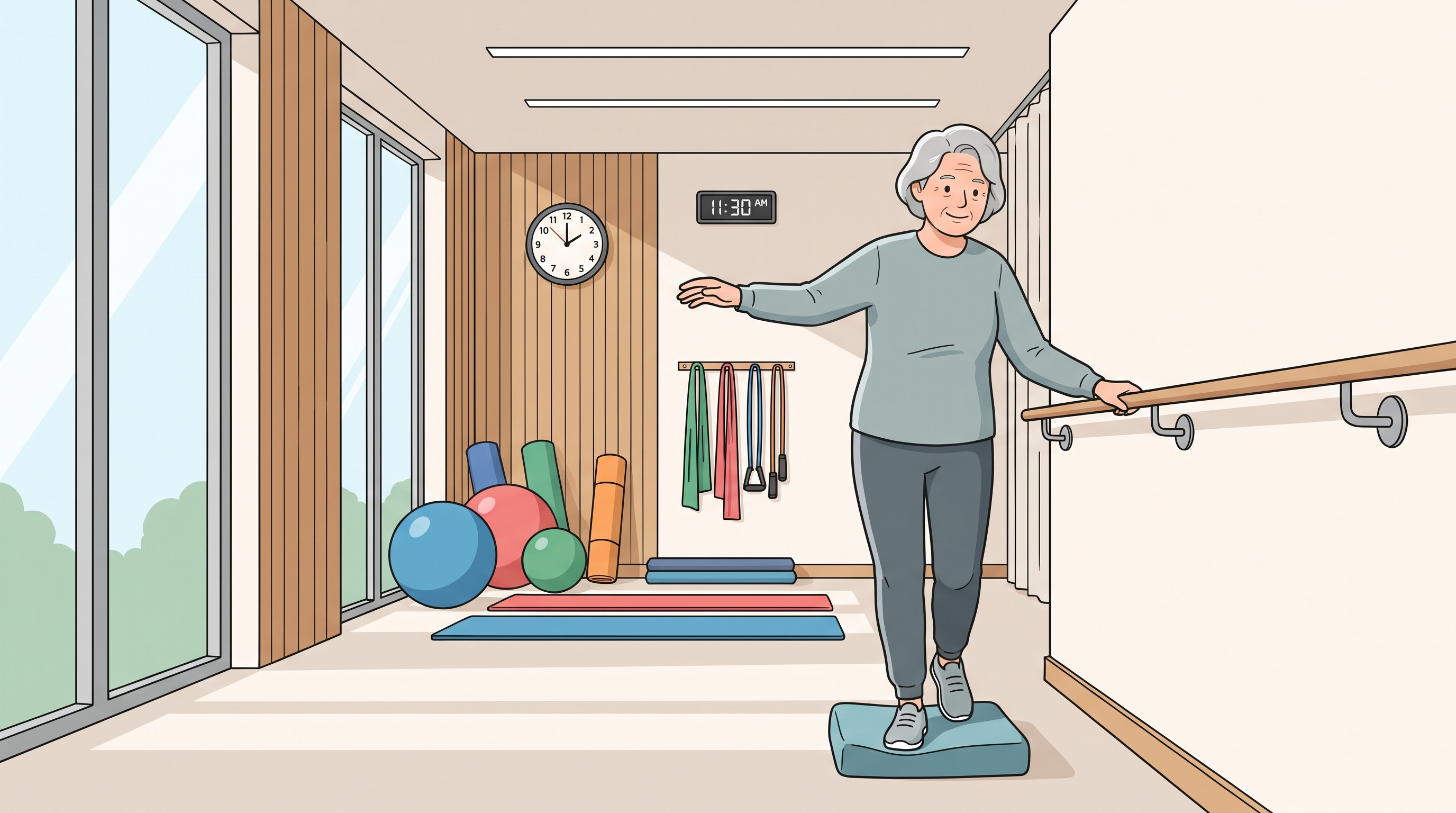
In rehabilitation facilities and clinics, longer gaps often open up between individual therapy sessions. For suitable patients, these periods can be used to continue agreed movement and training content independently. This does require clear structures, though: who is allowed to train on their own? Which exercises are suitable? Which safety rules apply? And how are these training activities fed back into the ongoing course of therapy?
Make the gaps in the daily schedule visible first
Before you create a new offering, it is worth taking stock. The first thing that matters is when suitable time windows actually occur and how they can be integrated into the existing ward and therapy routine.
Over a limited period, you could record the following points, for example:
- the length and timing of therapy-free windows for different patient groups
- weekdays or times of day with a lower therapy density
- the proportion of patients who are already active on their own between sessions
- available rooms and training areas
- overlaps with nursing, medical and diagnostic appointments
- staff responsibilities and availability during possible training times
This overview tells you at which times supplementary self-training can sensibly be offered from an organisational point of view at all.
Three possible formats for guided self-training
Depending on the patient group, the available space and the level of support needed, different formats come into question. They can be used individually or in combination.
Room-based self-exercise programmes offer a low-threshold entry point. The therapist puts together a small number of clearly defined exercises that the patient can perform independently after an initial briefing. The advantage lies in the low organisational hurdle. At the same time, there is no immediate feedback on movement quality while the exercises are being carried out.
Self-training in a defined training area allows patients to perform previously practised training content in a dedicated space. What form of supervision or availability is required depends on the patient, on the training content and on the rules of the individual facility.
Scheduled self-training slots are built into the daily routine like any other appointment. This gives training a fixed place in the therapy plan and makes it easier to coordinate with nursing, diagnostics and other treatments.
Which format is appropriate should not be decided purely on the basis of organisational availability, but above all according to the individual patient's need for support and safety.
Approval criteria: Who can train independently
Self-training is not a blanket option for every patient. Whether independent or partly independent training is suitable should be assessed individually by the treating team.
A written set of criteria can help to make decisions transparent. Relevant points might include:
- sufficient orientation and the ability to understand the agreed training and safety rules
- sufficient physical and cognitive prerequisites for the intended exercises
- defined load limits and known relevant medical restrictions
- safe handling of any aids that may be required
- no current restrictions that argue against the planned form of training
- correct understanding and safe performance of the exercises in a previously supervised session
- the ability to notice symptoms and to stop training if necessary
A staged approach can also make sense. At the start, the patient performs the exercises under direct guidance. In the next step, familiar exercises can be carried out with less support. Only once safe performance is demonstrably assured does more independently organised training become an option.
If the patient's state of health changes, the approval must be reviewed again. That may be necessary after an infection, a worsening of symptoms, a change of medication or another relevant event, for example.
Set out supervision, safety and responsibilities clearly
When introducing a self-training offering, it should be unambiguously clear who is responsible for organisation, approval and safety. The requirements can differ depending on the facility, the patient group and the form of training, and should be agreed with the therapeutic and medical leadership as well as with internal rules.
Before you start, the following questions in particular should be settled:
- Who is responsible during the respective training times and how can that person be reached?
- Which patients may use the offering and who grants approval?
- Which safety and stop criteria apply?
- What emergency procedures are in place in the training area?
- How are patients briefed on the exercises and on any equipment used?
- How are relevant incidents or discontinued sessions documented?
- When does the patient need to be reassessed therapeutically or medically?
A short, easy-to-understand standard operating procedure can help to apply these points consistently in day-to-day ward life. The decisive factor is that all staff involved know the rules and that they are genuinely built into daily routines.
Patient activation in rehab with digital training support
One challenge with more independent training is that a therapist is not permanently standing right beside the patient while the exercises are performed. Digital training systems can support certain recurring tasks such as exercise prescription, movement feedback and training documentation.
The Pixformance Station is a digital training and therapy unit with an integrated camera system and a virtual trainer. Exercises are demonstrated on the display while the system captures the movement and provides immediate visual and written feedback.
Training plans can be prescribed therapeutically and adapted to the patient's individual goals. Training parameters are documented automatically and can then be viewed via the online platform.
For rehabilitation facilities and clinics, this kind of digital support can be particularly interesting wherever suitable patients are meant to repeat familiar exercises in a structured way. The decision as to whether a patient may train independently, which exercises are suitable and when therapeutic intervention is needed remains with the treating team.
Pixformance has also been studied in various clinical and scientific contexts. When assessing such results, the patient group studied, the specific study design and the particular field of application are always decisive.
| Criterion | Digital training station (Pixformance) | Exercise sheets | Home exercise apps | Supervised training |
|---|---|---|---|---|
| Guidance | via virtual trainer and stored training plan | via text and images | depends on the app, often via videos | directly from the therapist or trainer |
| Feedback during performance | automated visual and written feedback | no immediate feedback | depends on the particular application | individual feedback from the supervising professional |
| Training documentation | training data captured automatically | depends on manual documentation | depends on the application and data capture | therapeutic or organisational documentation required |
| Individual adaptation | training plan can be adapted therapeutically | only by adapting the programme | depends on the application and support | possible immediately |
| Manual and tactile support | not provided | not possible | not possible | possible immediately |
| Independent performance | supported by digital guidance and feedback | possible | a core element | depends on the support concept |
| Continuation outside the facility | possible via supplementary digital offerings | possible | often a core element | depends on a follow-on offering being available |
The different formats serve different purposes. For patients who need close therapeutic assessment, manual support or short-term adjustments to their daily form, personal supervision remains central.
A self-training offering should therefore not be seen as a replacement for therapy. It can complement therapy sessions by allowing suitable patients to repeat familiar, approved training content in a structured way between treatments.
Linking up with progress documentation
Self-training is most useful for the further course of therapy when the relevant information from it is available to the team. What matters is not the largest possible volume of data, but a small number of comprehensible pieces of information that are actually used for therapeutic decisions.
The article Digital exercise therapy: Which metrics really hold up describes which measurements are fundamentally suitable for this.
The facility should define:
- which information from self-training is documented
- which data is transferred into the patient record
- who checks or transfers this information
- at which points it is taken into account in the therapeutic process
- which abnormalities trigger a new therapeutic assessment
Depending on the training concept, training frequency, completed exercises, load parameters and relevant symptoms or discontinued sessions can be taken into account, for example.
Not every automatically captured value has to be transferred into the patient record. What is important is that the selected information has a clear link to therapeutic decision-making.
You will find guidance on distinguishing between necessary treatment documentation and supplementary training data in the article Training documentation in physiotherapy: What really counts?.
Implementation: From pilot project to established routine
For the roll-out, it makes sense to start with a clearly defined area or a suitable patient group. That way, processes can be tested and adjusted before the offering is extended to other areas.
One possible approach:
- Identify time windows: Check when suitable training times arise between existing therapy, nursing and diagnostic appointments.
- Define the approval process: Determine which criteria a patient has to meet, who grants approval and when it is reviewed again.
- Standardise the briefing: Every patient should first get to know the intended exercises under supervision. That includes stop criteria and the applicable safety rules.
- Assign responsibilities: Set out who is available during training, who checks up on any irregularities and how relevant events are documented.
- Evaluate the results: After a defined test phase, review uptake, discontinued sessions, organisational problems and feedback from patients and staff, among other things.
For the economic and organisational assessment of capacity, staffing and digital training offerings, the Therapy Efficiency Report 2026 can also be consulted.
Conclusion: Free time only becomes training time through structure
Therapy-free windows alone do not create additional activity. For patients to use these periods meaningfully for movement and training, you need clear approval criteria, suitable exercises, defined responsibilities and a link to the ongoing course of therapy.
Digital support can help to guide familiar training content, give feedback on movement quality and capture training data in a comprehensible way. The therapeutic decision about who can train independently and how training is adapted, however, remains with the treating team.
That way, self-training does not become a detached add-on, but a structured part of everyday rehab.
Frequently asked questions
At what point are patients in rehab allowed to exercise independently?
That is decided by the interdisciplinary team on the basis of a written set of criteria. Typical requirements are orientation and the ability to retain information, a stable cardiovascular situation, medically defined load limits, safe transfers and at least one supervised run-through of the exercises. A staged model has proved its worth: from the guided session, through practising within sight, to independent training in a fixed time slot. Any approval can be withdrawn at any time.
How can self-training on the ward be organised without additional staff?
The key elements are fixed time slots, approved patient groups and a named supervisor within calling distance rather than permanent one-to-one support. Formats that can guide several people at once are helpful. A digital training station from Pixformance, for example, allows up to four people to train at the same time and gives corrective feedback during performance, so the staff member is not tied to the equipment throughout.
Which data from self-training belongs in the progress documentation?
A small selection that stays comparable across the whole stay makes sense: training frequency, exercises completed and a quality or load indicator. These values can be discussed on the ward round. Further detailed data stays in the training system and is only consulted for specific questions. It is important to set out clearly who transfers the values and at what intervals.
Read more

Movement analysis in physiotherapy: What real-time feedback can do
Sensor-based systems can capture movements as they happen and give immediate feedback. This article explains which measurements can be useful for training control, how feedback is best used and where therapeutic judgement remains irreplaceable.
Training equipment in physiotherapy: Calculating the costs realistically
A clear calculation framework for your training area: record fixed costs properly, estimate occupied hours honestly, assess how much staff time is tied up, and derive the utilisation level you need.

Organising equipment-based exercise therapy: Space and flow
How practices plan and schedule their training area so that one therapist can safely supervise several patients in parallel – from the layout of the floor space to handovers between shifts.